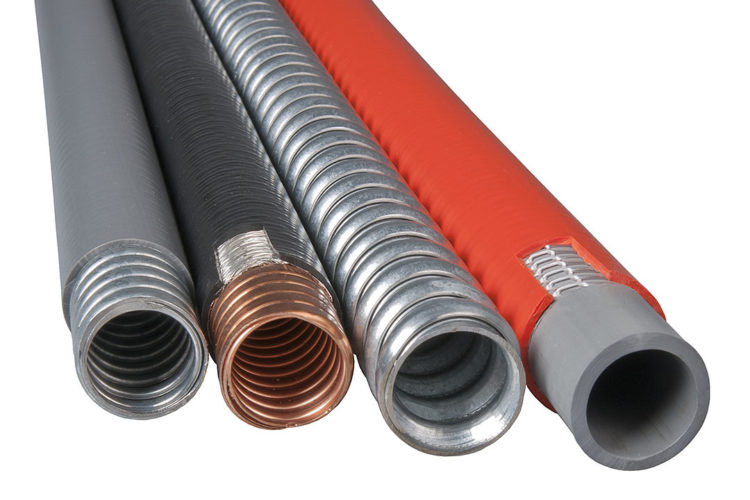
Conduit Fill Chart and Wire Fill Tables
A conduit fill chart shows how much of a conduit’s interior cross-section can be occupied by conductors. The charts below give allowable fill area in square inches by trade size for flexible metal conduit (FMC), liquidtight flexible metal conduit (LFMC), and nonmetallic conduit in Type A and Type B constructions.
Conduit fill table: allowable fill area in square inches by trade size. Fill limits per NEC Chapter 9, Table 1. Conduit dimensions per NEC Chapter 9, Table 4.
| Conduit Wire Fill Charts | ||||||||||
|---|---|---|---|---|---|---|---|---|---|---|
| Per National Electrical Code - Chapter 9, Table 4 | ||||||||||
| Flexible Metal Conduit - BR, ABR | Liquidtight Flexible Metal Conduit - LA, LT, EF, ATLA, AT, ATX, ALT, ZHLA, CEA, CSA, VJC, LAFG, LAFG-SS, LA-SS, ZHLA-SS, ATX-SS, ATLA-SS, CBLA | |||||||||
| Trade Size (in.) | Internal Diameter (in.) | Total Area 100% (sq. in.) | 2 Wires 31% (sq. in.) | Over 2 Wires 40% (sq. in.) | 1 wire 53% (sq. in.) | Internal Diameter (in.) | Total Area 100% (sq. in.) | 2 Wires 31% (sq. in.) | Over 2 Wires 40% (sq. in.) | 1 wire 53% (sq. in.) |
| 3/8 | 0.384 | 0.116 | 0.036 | 0.046 | 0.061 | 0.494 | 0.192 | 0.060 | 0.077 | 0.102 |
| 1/2 | 0.635 | 0.317 | 0.098 | 0.127 | 0.168 | 0.632 | 0.314 | 0.097 | 0.126 | 0.166 |
| 3/4 | 0.824 | 0.533 | 0.165 | 0.213 | 0.282 | 0.83 | 0.541 | 0.168 | 0.216 | 0.287 |
| 1 | 1.02 | 0.817 | 0.253 | 0.327 | 0.433 | 1.054 | 0.872 | 0.27 | 0.349 | 0.462 |
| 1-1/4 | 1.275 | 1.277 | 0.396 | 0.511 | 0.677 | 1.395 | 1.528 | 0.474 | 0.611 | 0.81 |
| 1-1/2 | 1.538 | 1.857 | 0.576 | 0.743 | 0.984 | 1.588 | 1.979 | 0.613 | 0.792 | 1.049 |
| 2 | 2.04 | 3.269 | 1.013 | 1.308 | 1.733 | 2.033 | 3.245 | 1.006 | 1.298 | 1.72 |
| 2-1/2 | 2.5 | 4.909 | 1.522 | 1.964 | 2.602 | 2.493 | 4.879 | 1.512 | 1.952 | 2.586 |
| 3 | 3 | 7.069 | 2.191 | 2.828 | 3.747 | 3.085 | 7.475 | 2.317 | 2.99 | 3.962 |
| 3-1/2 | 3.5 | 9.621 | 2.983 | 3.848 | 5.099 | 3.52 | 9.731 | 3.017 | 3.892 | 5.157 |
| 4 | 4 | 12.566 | 3.895 | 5.026 | 6.66 | 4.02 | 12.692 | 3.935 | 5.077 | 6.727 |
| Flexible Nonmetallic Conduit Type A - LNMP | Liquidtight Nonmetallic Conduit Type B - NM, NMHT, NMFG, NM2 | |||||||||
| Trade Size (in.) | Internal Diameter (in.) | Total Area 100% (sq. in.) | 2 Wires 31% (sq. in.) | Over 2 Wires 40% (sq. in.) | 1 wire 53% (sq. in.) | Internal Diameter (in.) | Total Area 100% (sq. in.) | 2 Wires 31% (sq. in.) | Over 2 Wires 40% (sq. in.) | 1 wire 53% (sq. in.) |
| 3/8 | 0.495 | 0.192 | 0.06 | 0.077 | 0.102 | 0.494 | 0.192 | 0.06 | 0.077 | 0.102 |
| 1/2 | 0.63 | 0.312 | 0.097 | 0.125 | 0.165 | 0.632 | 0.314 | 0.097 | 0.126 | 0.166 |
| 3/4 | 0.825 | 0.535 | 0.166 | 0.214 | 0.284 | 0.83 | 0.541 | 0.168 | 0.216 | 0.287 |
| 1 | 1.043 | 0.854 | 0.265 | 0.342 | 0.453 | 1.054 | 0.872 | 0.27 | 0.349 | 0.462 |
| 1-1/4 | 1.383 | 1.501 | 0.465 | 0.6 | 0.796 | 1.395 | 1.528 | 0.474 | 0.611 | 0.81 |
| 1-1/2 | 1.603 | 2.017 | 0.625 | 0.807 | 1.069 | 1.588 | 1.979 | 0.613 | 0.792 | 1.049 |
| 2 | 2.063 | 3.341 | 1.036 | 1.336 | 1.771 | 2.033 | 3.245 | 1.006 | 1.298 | 1.72 |
NPT threaded fitting sizes and knockout diameters by conduit trade size.
| NPT Threaded Fittings | NPT Threaded Fittings - Knock Out Diameter | |||||||||
|---|---|---|---|---|---|---|---|---|---|---|
| 3/8 | 1/2 | 7/8 | ||||||||
| 1/2 | 1/2 | 7/8 | ||||||||
| 3/4 | 3/4 | 1-3/32 | ||||||||
| 1 | 1 | 1-23/64 | ||||||||
| 1-1/4 | 1-1/4 | 1-23/32 | ||||||||
| 1-1/2 | 1-1/2 | 2 | ||||||||
| 2 | 2 | 2-1/2 | ||||||||
Length, weight, and temperature conversions for working between imperial and metric specifications.
Common Conversions
| Length | Weight | Temperature |
|---|---|---|
| 1 Foot = 0.305 Meters | 1 Pound = 454 Grams | °C = Degrees Centigrade |
| 1 Meter = 3.281 Feet | 1 Pound = 0.454 Kilograms | °F = Degrees Fahrenheit |
| 1 Inch = 25.4 Millimeters | 1 Kilogram = 2.205 Pounds | °C = (°F - 32) ÷ 1.8 |
| 1 Millimeter = 0.039 Inches | 1 Gram = 0.035 Ounces | °F = (°C x 1.8) + 32 |
| 1 Inch = 2.54 Centimeters | 1 Ounce = 28.349 Grams | |
| 1 Centimeter = 0.394 Inches |
What Are the NEC Conduit Fill Limits?
The National Electrical Code sets maximum conduit fill as a percentage of the conduit’s total interior cross-sectional area. The percentage depends on how many conductors the run carries, and it applies to the combined area of every conductor in the run.
- One conductor: 53 percent
- Two conductors: 31 percent
- Three or more conductors: 40 percent
Two conductors carry the lowest allowance because a pair of round conductors packs inefficiently inside a round conduit, and the risk of jamming during a pull rises.
These limits come from NEC Chapter 9, Table 1. You can read NFPA 70 through NFPA’s free online access. Registration is required.
How Do You Calculate Conduit Fill?
Conduit fill is calculated by adding the cross-sectional areas of every conductor in the run and comparing that total against the allowable fill area for the conduit. The charts above provide the allowable area. Conductor areas come from NEC Chapter 9, Table 5, which lists dimensions by insulation type and conductor size.
Which Fill Chart Applies to Your Conduit Type?
Interior area differs by construction, so a jacketed conduit and an unjacketed conduit of the same trade size do not carry the same allowance. Read from the block that matches the product you are specifying.
Liquidtight Conduit Fill Chart (LFMC)
Liquidtight flexible metal conduit places a jacket over a metal core. The liquidtight conduit fill chart above covers our full LFMC range, including Types LA, LT, and CBLA, along with specialty constructions such as zero-halogen conduit (Type ZHLA) and food-grade conduit (Type LAFG). Jacket compound varies across these types. Interior dimensions do not, so one set of values serves the whole LFMC range.
See the full liquidtight conduit line and specifications.
Flexible Conduit Fill Chart (FMC)
Flexible metal conduit carries no jacket, and its interior area differs from jacketed conduit across most trade sizes. The flexible conduit fill chart above covers Types BR and ABR.
Browse the full flexible conduit range by family.
Liquidtight Flexible Nonmetallic Conduit Fill Chart
Nonmetallic conduit appears on the chart above in two constructions. Type A covers Type LNMP. Type B covers Types NM, NMHT, NMFG, and NM2. Interior areas differ between the two, so confirm which construction your product uses before reading a value.
Search nonmetallic conduit by type and size.
Conduit Fill Chart FAQs
Does conduit fill include the equipment grounding conductor?
Yes. Every conductor in the run counts toward fill, including neutrals and equipment grounding conductors. Where bare conductors are permitted, use the dimensions in NEC Chapter 9, Table 8 rather than Table 5.
Do these charts cover EMT, IMC, or rigid conduit?
No. These charts cover the flexible conduit types we manufacture: flexible metal conduit, liquidtight flexible metal conduit, and nonmetallic conduit. For EMT, IMC, rigid metal conduit, or PVC, you will need a pipe fill chart covering rigid conduit and tubing, found in the corresponding sections of NEC Chapter 9, Table 4.
How is a multiconductor cable counted in conduit fill?
A multiconductor cable is treated as a single conductor when calculating percentage fill. For cables with an elliptical cross-section, base the area calculation on the major diameter of the ellipse treated as a circle diameter.
What happens if a conduit exceeds the fill limit?
Overfilled conduit traps heat, which degrades conductor insulation over time. It also raises pulling tension during installation, increasing the risk of jacket damage, and it will not pass inspection. Additionally, overfilling can also reduce the performance of the conduit’s flexibility.