


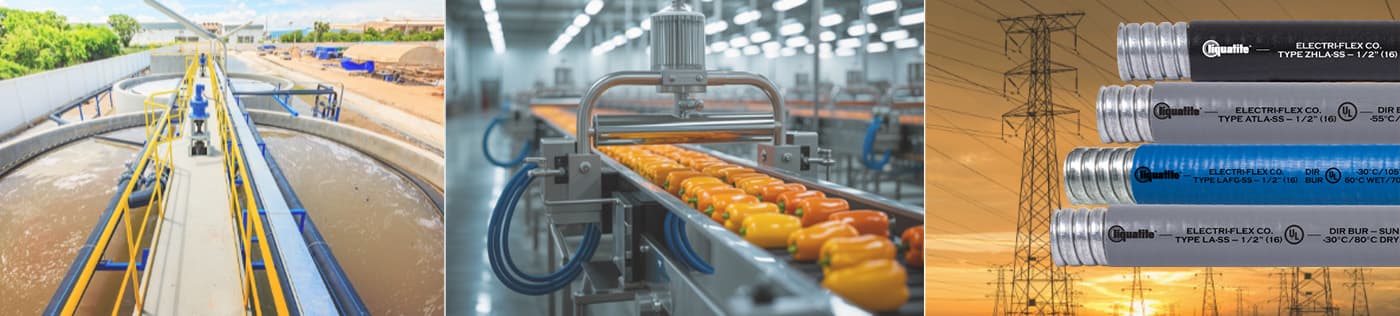
Stainless Steel Flexible Conduit
Stainless steel flexible conduit is constructed with a spiral-wound stainless steel core in place of the galvanized steel used in standard conduit. This construction provides superior corrosion resistance and increased crush strength, making it well suited for demanding applications exposed to moisture, washdown and sanitation processes, chemicals, marine air, wastewater, and industrial oils and fluids. A protective liquidtight jacket provides an additional layer of protection against harsh environmental conditions.
Stainless steel flexible Liquatite® conduit, by Electri-Flex Company, is a line of UL-listed jacketed types: LA-SS, ATLA-SS, ZHLA-SS, LAFG-SS, and non-UL ATX-SS. These lines of flexible electrical conduit offer exceptional resistance to corrosive atmospheres, as well as high mechanical strength.

Best Applications for Stainless Steel Flexible Conduit
Stainless steel electrical conduit is ideal for corrosive environments, such as:- Chemical processing
- Water treatment plants
- Oil & gas refineries
- Food processing
- Healthcare
- Wastewater treatment
- Shipbuilding
- Defense
- Steel mills
- Power plants
- Transportation
- Utilities
- Marine applications
Flexible Conduit Solutions for Every Need
For applications that demand more from flexible conduit, stainless steel options provide enhanced corrosion resistance, durability, and specialized performance. Available constructions are designed for food-grade, zero-halogen, industrial, and extreme-temperature applications while meeting a range of industry requirements. All stainless steel options are part of the broader jacketed metallic conduit family.
Specialty product features include, but are not limited to:
- Antimicrobial Food Grade/NSF Certified
- Industrial Grade
- Halogen-Free
- Low Smoke Zero Halogen
- Extreme High/Low Temperature
- Excellent Corrosion Resistance
- Jacketed Conduits are Liquidtight
- Non-Magnetic
- Higher Crush Strength vs. Standard Steel Core
Product Line Overview
Five stainless core types cover the range. Four carry UL listing. Type ATX-SS is non-UL and trades that for the widest temperature range in the group.- Type LA-SS (formerly LTSS) – A flexible stainless-steel UL-listed, liquidtight conduit, offering protection against sunlight (UV), and wet, oily conditions. Ideal for industrial-grade installations requiring motion, vibration, and bending, and is also listed for direct burial.
- Type ATLA-SS (formerly ATSS) – Designed for extreme hot or cold environments, this UL-listed conduit features a specially formulated PVC jacket that stays flexible at low temperatures and resists aging at high temperatures. It is flame-retardant, sunlight (UV) resistant, and is suitable for direct burial. Working temperatures: -55°C through 105°C Dry / 60°C Wet / 70°C Oil.
- Type ZHLA-SS (formerly ZHSS) – A UL-listed low smoke, zero-halogen, low fire hazard solution for environments requiring limited toxic material release, such as subways, tunnels, and public spaces. Meets ASTM E162 (Flame Spread), ASTM E662 (Smoke Generation), Bombardier SMP800-C (Toxic Gas Generation), and is NFPA 130 approved. Resistant to chemicals, oils, and sunlight (UV).
- Type LAFG-SS (formerly LSSFG) – An antimicrobial, NSF-certified, UL-listed conduit designed for food processing and sanitary environments. Made with a flexible, FDA-approved PVC compound suitable for “splash zone” food and beverage contact, and meeting FDA CFR21 and NSF 51/61 requirements. It is flame-retardant and is resistant to oils, mild acids, and sunlight (UV).
- Type ATX-SS (formerly ATXSS) – A non-UL liquidtight stainless steel flexible conduit designed to withstand an extreme temperature range. It is UV stabilized, halogen-free, and offers a flame rating of UL94-HB. Working temperatures: -60°C through 150°C, intermittent to 165°C.
Grounding Stainless Steel Conduit
A stainless steel core cannot act as the equipment grounding conductor. Every stainless type on this page needs a wire-type equipment grounding conductor or a bonding jumper, sized under NEC 250.118. Standard galvanized steel liquidtight conduit is permitted to ground within defined limits of trade size, amperage, and run length. Stainless is not, so account for the extra conductor before you size the run against our conduit fill chart.Stainless Steel Conduit FAQs
Why is a stainless steel core more corrosion-resistant than galvanized steel?
Galvanized steel conduit relies on a zinc coating to shield the steel underneath, however a stainless core resists corrosion through the alloy itself rather than a surface layer, so performance does not depend on the coating staying intact. This resistance to corrosion stems from their ranking on the Galvanic Series.Can stainless steel flex conduit be directly buried?
Types LA-SS, ZHLA-SS, and ATLA-SS are listed for direct burial. That listing is type-specific rather than a property of the stainless core, so check the listing on the type you are specifying instead of assuming it applies across the whole line.Is corrosion-resistant conduit available in food-grade and zero-halogen versions?
Yes. Type LAFG-SS is the antimicrobial, NSF-certified food-grade construction, and Type ZHLA-SS is the low-smoke, zero-halogen construction. Both are built on the same stainless core as the standard industrial types.Which stainless steel type handles the widest temperature range?
Type ATX-SS, at -60°C through 150°C with intermittent service to 165°C. It is the one non-UL type in the line, so where a UL listing is required, and the range still runs wide, Type ATLA-SS covers -55°C through 105°C dry.Technical Article
To learn more about the benefits of stainless steel over aluminum or standard steel, download the technical article Stainless steel conduit: A solution for any harsh environment to uncover why it is the chosen leader for harsh environments. Not sure which stainless type fits your installation? Find a sales representative, and they will walk through the specification with you. Search Stainless Steel products. Search Now